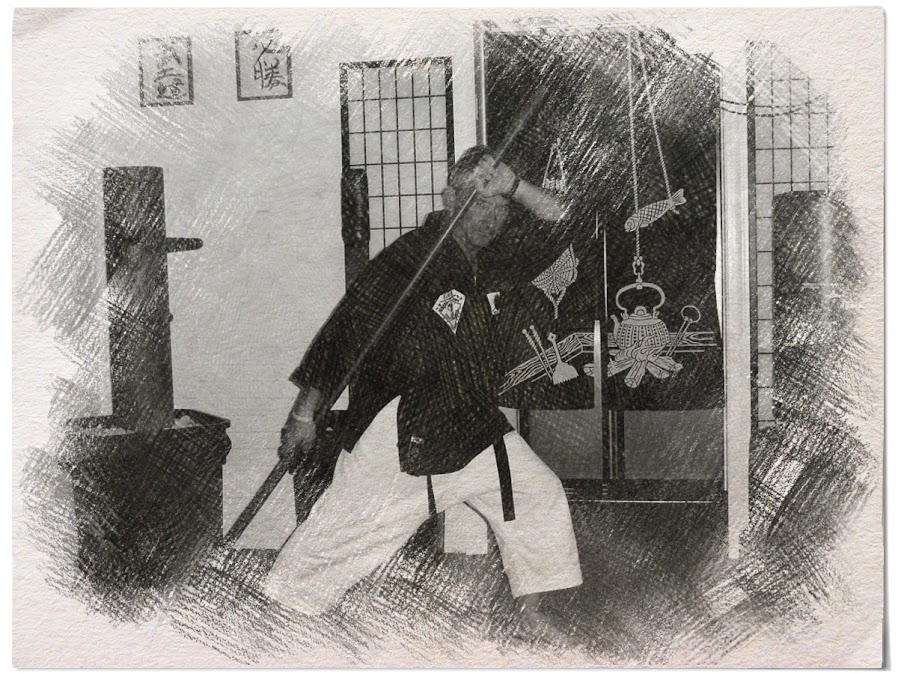
The methods of instruction within our Dojo come from the common thread of most karate lineages. Kanga "Tode" Sakugawa (1733-1815) is credited with the foundation of Okinawan Te. He was the student of Kusanku, the Chinese agent who was stationed in the Ryukyu Islands. Sakugawa was also the teacher of karate's most famous teacher, Sokon "Bushi" Matsumura, who in turn was the teacher of Ankoh Itosu, who developed the "Seito Karate" that was then passed to Japan and from there to the rest of the world. The lineage of Itosu Sensei included a virtual who's who in the world of Karate. Men like Chosin Chibana, Chomo Hanashiro, Kentsu Yabu, Kanken Toyama, Gichin Funakoshi, Kenwa Mabuni, Hiroshi Kinjo, and Mitani Kazuya have all followed in his steps.
There were of course many more important teachers in Okinawan history that have made an impact on our Dojo. The lineage's of Kanryo Higaonna, Kanbun Uechi, Matayoshi Shinpo, Shinken Taira, Shigeru Nakamura, and Seikichi Odo to name but a few.
The methodology within the our Dojo is also somewhat comprehensive, encompassing the practice of a number of specialized categories of techniques which are ultimately integrated into the syllabus of it's practitioners. They are the core strategy in the ability to use the four points of survival.....Evade/Receive, Stun, Incapacitate, and Eliminate the opponent. Only when these four steps are complete are you safe to engage another opponent, or to move to your ultimate safety.
These include Tachi waza (stances) and how to move while maintaining balance. Central to this theory is the Tai Sabaki, or the ability to change body positions and to evade the attack of your opponent, these are used in conjunction with Uke waza (receiving techniques).
Tsuki waza (punching techniques), Uchi waza (striking techniques), and Geri waza (kicking techniques) are frequently practiced on the Makiwara, hanging Bags, and on the Chinese Mook Jong, or wooden man.
Kansetsu waza (techniques applied to joints), Osaekomi waza (techniques of holding and immobilizing), Shime waza (choking techniques), Nage waza (techniques of throwing), Torite or Tuide waza (techniques of grappling) and Ukemi waza (methods of falling and rolling) are derived from ancient techniques originating in Japan, and used for hundreds if not thousands of years by the Samurai warriors.
There is also training in the use of various ancient weapons (Okinawa Kobudo), including the Bo (staff), Sai (three pronged short sword), Kama (sickles), Tonfa (wood handles), Nunchaku (flail), Eku (Okinawan boat oar), the Tekko (knuckle dusters), Ticchu (hand spike), Jiffa (hairpins), and the Kuwa (common garden hoe).
Many of these techniques were devised in Okinawa proper, but many were also part of the ancient Japanese art of Jujitsu. One must understand the history of Okinawa to fully realize the impact of all the influences that came into Okinawa from China and Japan, in order to see how the karate we know today actually came into existence.
There were of course many more important teachers in Okinawan history that have made an impact on our Dojo. The lineage's of Kanryo Higaonna, Kanbun Uechi, Matayoshi Shinpo, Shinken Taira, Shigeru Nakamura, and Seikichi Odo to name but a few.
The methodology within the our Dojo is also somewhat comprehensive, encompassing the practice of a number of specialized categories of techniques which are ultimately integrated into the syllabus of it's practitioners. They are the core strategy in the ability to use the four points of survival.....Evade/Receive, Stun, Incapacitate, and Eliminate the opponent. Only when these four steps are complete are you safe to engage another opponent, or to move to your ultimate safety.
These include Tachi waza (stances) and how to move while maintaining balance. Central to this theory is the Tai Sabaki, or the ability to change body positions and to evade the attack of your opponent, these are used in conjunction with Uke waza (receiving techniques).
Tsuki waza (punching techniques), Uchi waza (striking techniques), and Geri waza (kicking techniques) are frequently practiced on the Makiwara, hanging Bags, and on the Chinese Mook Jong, or wooden man.
Kansetsu waza (techniques applied to joints), Osaekomi waza (techniques of holding and immobilizing), Shime waza (choking techniques), Nage waza (techniques of throwing), Torite or Tuide waza (techniques of grappling) and Ukemi waza (methods of falling and rolling) are derived from ancient techniques originating in Japan, and used for hundreds if not thousands of years by the Samurai warriors.
There is also training in the use of various ancient weapons (Okinawa Kobudo), including the Bo (staff), Sai (three pronged short sword), Kama (sickles), Tonfa (wood handles), Nunchaku (flail), Eku (Okinawan boat oar), the Tekko (knuckle dusters), Ticchu (hand spike), Jiffa (hairpins), and the Kuwa (common garden hoe).
Many of these techniques were devised in Okinawa proper, but many were also part of the ancient Japanese art of Jujitsu. One must understand the history of Okinawa to fully realize the impact of all the influences that came into Okinawa from China and Japan, in order to see how the karate we know today actually came into existence.
About the Kata of Karate…
By Mitani Kazuya
There is a big mis-apprehension in foreign countries today that Japanese people study a large number of kata. Perhaps some did a long time ago but our seniors (sempai) were happy to study just two or three to great length. It is not useful to learn a great number of kata. Kata is not technology (waza) but a style (yoshiki). It is not the style but the technology of fighting that is useful to us. Technology is in a style but the style itself is not technology.
Thus the great difference in the relationship between a style and technology is not usually known. Traditional karate differs greatly from other karate at this point. Although many do not know of this truth, this is the difference between Shurite and other karate.
There are very few kata that relate to kumite. The only karate kata that I teach my students are Naifanchi Shodan and Pinan Nidan. I use the technology from these kata in kumite competition.
Pinan Nidan
Pinan Nidan is the simplest kata. It is the stepping punch (oi-zuki) and the correct timing and proper distance (maniau) that I teach from Pinan Nidan. The stepping punch is delivered before the foot lands. It is the method of putting weight into a punch. It is the gift from Matsumura that this technique derives.
Naifanchi
There is no oi-zuki in the kumite lesson from Naifanchi. One of the features is not switching the body. It is “ushiro-te sabaki maete-zuki” that is demonstrated. It means that kizami-zuki is carried out, by defending with the rear hand. This is difficult waza in a kumite tournament. Therefore, I only teach this to experienced adult competitors.
I teach neither sanbon kumite nor ippon kumite. I do not teach ido kihon either. This kihon is for kata, not for karate. I think it is a big mistake and will not lead to understanding karate. I carry out the methods for practicing original karate. Karate practice methods are not about learning kata. Karate practices fighting techniques by using a makiwara. This is the difference between true karate and other karate. The “10 teachings of Itosu” is our textbook. Study it closely, and you will understand.
When we hear the word karate, we are apt to fall into the illusion that we are to be carrying out punches and kicks.
However, kumite (striking at each other) leads into toride (grappling) and concludes with nage (throwing).
If the opponent comes and grabs our body, there is no need for kumite. If he grabs our arm, we perform a chudan-uke (mid level block) into a toride technique. If he grabs our shoulder we perform a jodan-uke (high block) into a toride technique. A grab is slower than a punch so it is easy to grasp his arm.
Leaving the mental aspect aside for a while, even the technical goal of karate is not to blast people into oblivion with punches and kicks. The kata (fixed exercise routines) show us this.
Without understanding the kuden (oral transmissions) and only interpreting kata in one’s own way, one will never come to understand karate.
The precepts of Itosu state this clearly:
“Attack, receive, release and grappling all have many oral transmissions associated with their use.”
I often see those who throw their opponent with a Judo or Aikido technique and then finish him off with a punch; but this is actually backwards. We can do little more than call this ‘karate for one’s own personal satisfaction’.
It is not that easy to throw a person, and as an entry, we have kumite and toride.
This is also clearly stated in the precepts of Itosu:
“Swear to not harm people with your fists and feet.”
Makiwara (target- maybe wood, punching bag or a partner) practice centers on kumite and toride, but that does not make it wrong to practice throwing as well. Matsumura Sokon Sensei developed this from an old Jigen- Ryu Kenjutsu training method.
“One must practice the outer art of karate many times, as well as study how they are used.”…. “If one were to spend 1-2 hours a day at the makiwara…”
In other words, it is necessary to practice kata many times, but it is more important to practice the techniques in the kata at the makiwara for 1-2 hours a day.
Isn’t mainland Japanese karate amiss in this aspect? I will go into more detail on this elsewhere, but the purpose of karate training is to gain the power to throw an opponent. Without understanding what karate is, this point is not easy to grasp.
Mitani Kazuya,
Okinawa Seito Karate-do Seitokukai
I have already written on Kihon-gata and Kihon for Kumite. If Kumite and Tuite are the actual techniques, then kata is the Kihon.
This is the theory of Karate practice as written in Itosu’s 10 lessons, i.e. to learn Kumite through Kata and to practice on the Makiwara. I also learned this way, but I was interested in how styles other than Karate did things as well. Especially the competitive format as developed by the JKA.
As I watched this format, I believed that Karate could also be used in this arena, so I participated in the modern arena. I believed that 70-80% of Karate techniques could be used there. And, just as I thought the athletes from my organization showed the power of Karate. I also have interest in other styles fighting techniques.
Leaving this alone for a while, I also hear that Karate is based on kata, or that it is a Budo passed on through kata. I have believed this way of thinking was a bit odd over the years. The different kinds of Te probably had this tendency, but the Te of Matsumura had to have been Kumite and Tuite. The concept of “being in time” that Matsumura passed on shows this.
Karate uses Kumite and Tuite as its central practice as well, according to Itosu’s 10 precepts. Hanashiro Chomo Sensei (Kinjo Sensei’s teacher) wrote his “Karate Kumite” in 1905, the year Karate was established, so Kumite existed right from the very beginning.
Leaving Tuite alone for a while, this means that Kumite was a central theme in Karate. Hanashiro Sensei was one of the originators of Karate, and he learned Matsumura’s Te, meaning that the same was true of Matsumura’s Te. Also, as we can see from the 10 Precepts, Tuite was also used in Karate.
Karate was practiced mainly solo, but it was not Kata practice. Even if you practice kata every day you will not improve at Karate. This is also generally misunderstood.
Itosu Sensei distinguished between Kumite and Tuite, but I believe this distinction is comparatively recent. I believe that they were considered the same in the past.
On the “Oshima Hikki,” Te is referred to as Kumiai-jutsu. The person who was responsible for bringing it to Ryukyu was Koshankin. Thinking on the existence of Kushanku Kata, then it must have been Koshankin who disseminated the Kumiai-jutsu on which this kata is based. This Kumiai-jutsu may have been dying out or lost by the time Matsumura came around (this is why Matsumura’s Te was created), but it was the first art transmitted.
This Kumiai-jutsu, as we can see from the kata, must have considered Kumite and Tuite as the same thing. Looking at Motobu Sensei’s “Watashi no Karate-jutsu” and “Okinawa Kenpo Karate-jutsu” (he says Karate but it is really Shuri-te), he shows many photos within grappling range, showing that Kumite and Tuite were not clearly distinguished. (Comparing these photos with the Kumite photos in later books, we can see that Motobu Sensei was actually good at what he was showing).
Kinjo Sensei is the same in this regard: when facing him and exchanging blows, you are invariably grappled and tied up. Thus, Kumite and Tuite are actually one in the same, but they were broken up for the purposes of analysis.
Mitani Kazuya
When we hear the word "Karate"
Authored by Kazuya Mitani; Translated by Joe Swift; Edited by Bob McMahonWhen we hear the word karate, we are apt to fall into the illusion that we are to be carrying out punches and kicks.
However, kumite (striking at each other) leads into toride (grappling) and concludes with nage (throwing).
If the opponent comes and grabs our body, there is no need for kumite. If he grabs our arm, we perform a chudan-uke (mid level block) into a toride technique. If he grabs our shoulder we perform a jodan-uke (high block) into a toride technique. A grab is slower than a punch so it is easy to grasp his arm.
Leaving the mental aspect aside for a while, even the technical goal of karate is not to blast people into oblivion with punches and kicks. The kata (fixed exercise routines) show us this.
Without understanding the kuden (oral transmissions) and only interpreting kata in one’s own way, one will never come to understand karate.
The precepts of Itosu state this clearly:
“Attack, receive, release and grappling all have many oral transmissions associated with their use.”
I often see those who throw their opponent with a Judo or Aikido technique and then finish him off with a punch; but this is actually backwards. We can do little more than call this ‘karate for one’s own personal satisfaction’.
It is not that easy to throw a person, and as an entry, we have kumite and toride.
This is also clearly stated in the precepts of Itosu:
“Swear to not harm people with your fists and feet.”
Makiwara (target- maybe wood, punching bag or a partner) practice centers on kumite and toride, but that does not make it wrong to practice throwing as well. Matsumura Sokon Sensei developed this from an old Jigen- Ryu Kenjutsu training method.
“One must practice the outer art of karate many times, as well as study how they are used.”…. “If one were to spend 1-2 hours a day at the makiwara…”
In other words, it is necessary to practice kata many times, but it is more important to practice the techniques in the kata at the makiwara for 1-2 hours a day.
Isn’t mainland Japanese karate amiss in this aspect? I will go into more detail on this elsewhere, but the purpose of karate training is to gain the power to throw an opponent. Without understanding what karate is, this point is not easy to grasp.
Mitani Kazuya,
Okinawa Seito Karate-do Seitokukai
About Kumite and Tuite
By Mitani Kazuya (Translated by Joe Swift from the Seitokukai Japanese language web site)I have already written on Kihon-gata and Kihon for Kumite. If Kumite and Tuite are the actual techniques, then kata is the Kihon.
This is the theory of Karate practice as written in Itosu’s 10 lessons, i.e. to learn Kumite through Kata and to practice on the Makiwara. I also learned this way, but I was interested in how styles other than Karate did things as well. Especially the competitive format as developed by the JKA.
As I watched this format, I believed that Karate could also be used in this arena, so I participated in the modern arena. I believed that 70-80% of Karate techniques could be used there. And, just as I thought the athletes from my organization showed the power of Karate. I also have interest in other styles fighting techniques.
Leaving this alone for a while, I also hear that Karate is based on kata, or that it is a Budo passed on through kata. I have believed this way of thinking was a bit odd over the years. The different kinds of Te probably had this tendency, but the Te of Matsumura had to have been Kumite and Tuite. The concept of “being in time” that Matsumura passed on shows this.
Karate uses Kumite and Tuite as its central practice as well, according to Itosu’s 10 precepts. Hanashiro Chomo Sensei (Kinjo Sensei’s teacher) wrote his “Karate Kumite” in 1905, the year Karate was established, so Kumite existed right from the very beginning.
Leaving Tuite alone for a while, this means that Kumite was a central theme in Karate. Hanashiro Sensei was one of the originators of Karate, and he learned Matsumura’s Te, meaning that the same was true of Matsumura’s Te. Also, as we can see from the 10 Precepts, Tuite was also used in Karate.
Karate was practiced mainly solo, but it was not Kata practice. Even if you practice kata every day you will not improve at Karate. This is also generally misunderstood.
Itosu Sensei distinguished between Kumite and Tuite, but I believe this distinction is comparatively recent. I believe that they were considered the same in the past.
On the “Oshima Hikki,” Te is referred to as Kumiai-jutsu. The person who was responsible for bringing it to Ryukyu was Koshankin. Thinking on the existence of Kushanku Kata, then it must have been Koshankin who disseminated the Kumiai-jutsu on which this kata is based. This Kumiai-jutsu may have been dying out or lost by the time Matsumura came around (this is why Matsumura’s Te was created), but it was the first art transmitted.
This Kumiai-jutsu, as we can see from the kata, must have considered Kumite and Tuite as the same thing. Looking at Motobu Sensei’s “Watashi no Karate-jutsu” and “Okinawa Kenpo Karate-jutsu” (he says Karate but it is really Shuri-te), he shows many photos within grappling range, showing that Kumite and Tuite were not clearly distinguished. (Comparing these photos with the Kumite photos in later books, we can see that Motobu Sensei was actually good at what he was showing).
Kinjo Sensei is the same in this regard: when facing him and exchanging blows, you are invariably grappled and tied up. Thus, Kumite and Tuite are actually one in the same, but they were broken up for the purposes of analysis.
Mitani Kazuya
